

Story by Paige St. John, The J-student | February 1, 1984
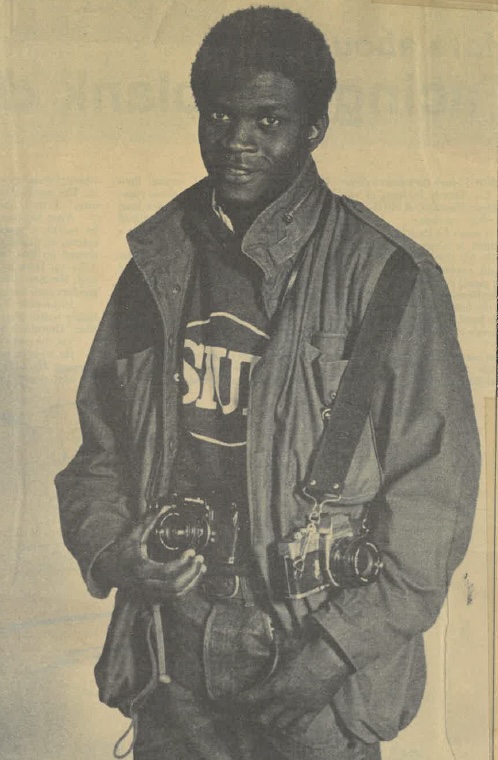
For a week, Michael Allen, a senior at SIUE, had been sleeping on a picnic table at the Tower Lake Recreation Area on campus.
Each evening in the summer dusk he jumped over the locked gate to the recreation area, and found his spot under a pavilion by the lake. He pulled off his clothes—a T-shirt and a pair of shorts—and rolled them into a bundle to pillow his head.
There he slept.
Before the sun came up he would be dressed again and gone … on the move, no place to live, dispossessed from the Tower Lake Apartments, living underground at the university.
“One night. I was asleep when I felt a light on me. I actually felt it. I got up and I didn’t have any clothes on and this light was on me,” Michael recalls. “I couldn’t believe that the policeman couldn’t see me.”
A campus patrol car was making a routine check of the recreation area with its car search light. Michael jumped up and ran behind one of the pavilion post, to avoid being seen.
The patrol car moved on.
“I couldn’t sleep that night,” Michael says. “In the morning, l got dressed and started to leave, but that police car was still parked there right at the gate. I had a very big problem at that point. I didn’t know how to swim so I couldn’t get across the lake that way. I had to walk around the edge of the lake (to the other side of the peninsula the recreation area sits on). I had to climb over the fence on that side.”
Then began his typical college day, scavenging for the necessities of life. In the mornings, he had no idea where he would eat, where he would sleep, whether he would be able to hang on at SIUE.
“That was quite exciting, doing that,” Allen now says. “Those were very big times. I enjoyed sleeping out there at night because it felt like the whole place, the whole world, was mine. The stars were beautiful. The one big disadvantage was the mosquitoes and the bugs. But the police scared me so much, after that night, I never went back to the Tower Lake rec area.
Michael Allen had to go underground because he had been evicted from his only place to stay. The problem started last June when he left the university’s Tower Lake Apartments with about $500 in back rent due. With a debt like that, he could not get a housing contract for the summer term at SIUE. He didn’t want to drop out of college, he had barely a term or two left before graduation.
Read more: Nigerian student degraded, homeless at SIUE“I just packed my stuff and look it over to Steve’s,” Allen says. Steve. a friend of his, rents a house. Michael’s belongings—everything but a pair of shorts and a T-shirt—were stored in the basement of the house.
For three months afterward, Allen had no place to live, no job, no money. He slept on campus, mostly in empty tract houses. He slept in the shed where athletic equipment is stored, using a high jump mat as a mattress. He slept on picnic tables. He slept occasionally on friends’ couches. In a few cases, on their doorsteps.
He borrowed money, he borrowed food, and a few times he borrowed clothes.
All of the time he stayed on campus, hoping things would get better.
Eventually, they did. By the end of the summer he found a job in St. Louis, qualified for student financial aid, paid off the debt to Tower Lake Housing, and was allowed back in.
Now he is found in his Tower Lake apartment, warm and clean and fed, making plans for graduation.
Michael Allen, who was born and raised in Nigeria, is among a small number of students hit hardest by hard times who somehow manage to stay in school and get their degrees.
Allen traces his troubles back to 1979 when he first enrolled at SIUE. He said he wanted to be a soccer player, but he never made the team. He thinks it is partly because he is a Nigerian, and the SIUE team prides itself on American boys.
An introverted person, he did not make many friends. “If I had had those friends, I would have had more people to go to for help when I needed it,” he says.
Allen was not as lucky. His best friend was a resident manager at Tower Lake, whose responsibility, unfortunately, is to see that only paying customers stay in the apartments.
Michael went to other acquaintances. After awhile, they began to disappear.
“Along the way, as time passed, those people got fewer and farther in between. I couldn’t blame them. I wouldn’t want someone who is depressed hanging around me all of the time.”
For three years at SIUE, Michael Allen was a successful student with above-average grades. He had an occasional withdrawal from class or low grade, but the A’s and B’s on his academic transcript show he was doing well.
In the fall of l982 he found a job at the Kroger store in Edwardsville, working the night shift as a janitor. Just one month later, he was offered a part-time job at the Belleville News Democrat. As a a journalism student, he jumped at the chance to be a reporter. He quit his janitorial job.
Four months later, he says, he found himself in the editor’s office, being told someone else was being hired to replace him at the newspaper.
He was being fired.
“My whole world just fell right at my feet,” Michael says. “That was one big disappointment then. But, it was only a setback. I had saved some money. I figured, hey, I would go for the Capital Cities (newspaper) internship program.”
In March Michael Allen was turned down for the paying internship program. He had seemed a likely candidate for the job until the typing test. Michael could not type.
He sleeps in tract houses and empty sheds
“It floored me. I think I even started missing classes then, and I don’t miss classes at all,” he said.
Winter quarter was hard on Michael. “I let everything slip by. I couldn’t pay my fees and I couldn’t pay my rent. I started doing things to get by. I would borrow $5 here and there from friends. Soon, those things began to pile up on me.”
He was, all the time, trying to find another job.
“I tried everything. I started applying for a janitorial job. l think things were quite rough for everyone that point, because there were no jobs at all. I kept thinking it was something else. It is very hard to say to yourself it’s got to be me.”
Depressed, he stopped going to classes. “Things were pretty bad but I should have been able to do something. But for some reason, I couldn’t do anything … ! don’t know if I can use the words ‘couldn’t do anything.’ I DIDN’T do anything.”
Psychologically, he was paralyzed.
The end of spring quarter came and he had to give up his Tower Lake home.
One of the people Michael eventually went to for help—after living for several weeks hand to mouth—was then-Dean of Students Dan Doelger. It was Doelger’s job to take care of problem student cases. Doelger could not provide students with instant housing or instant money or instant campus jobs. He could, however, pull a few strings to speed up the promise of help.
The university does make emergency short-term loans to students, but only if they do not owe money to the school. Michael Allen owed money.
Michael Allen applied for a state educational grant soon after he lost his Tower Lake apartment. He would not get the money, if he qualified, for several months. It was up to him to find a way to live until then.
He stayed and became a bag man.
“I had a bag—a shopping bag—and in it was a towel, a toothbrush and a tube of toothpaste and a blanket. I kept it in my car, which was parked by Tower Lake. It had no gas in it and I couldn’t move it anyhow. The window broke and when it rained my stuff got wet.”
After a week of sleeping at the lake, he had his escapade with the patrol car. He had to find someplace else to stay.
“I borrowed $20 from Joe, a friend, and put some gas in my car. I drove it to the soccer field parking lot and I was going to sleep in it there. Before I know it, there was a police car. He told me I couldn’t sleep there.”
Allen drove the car back to Tower Lake, parked it and then walked back to the soccer field. There are two sheds on one side of the track field behind the soccer field. One of them had a high jump mat inside it. That became home for the nights.
“I’d take a semi-shower at the water fountain in the morning,” he said. “During the day I went to places to try to find a job. Granite City, the Ramada Inn . . . all the time I was starving. I know starving, there was never a time in my life when I didn’t starve, so it wasn’t so bad.”
Michael Allen was raised in Nigeria. Hunger is familiar to him, he says. “I thought coming to the United States was going to be paradise. People do not starve in the United States.”
He laughs at his naivete.
Occasionally it was too cool to sleep on the high jump mat. Sometimes, too, the mosquitoes were too fierce. Then, Michael would cross the street to an empty tract house where the Human Services Department once was located.
“For a long time, most of the summer, I slept at the tract house or the shed.”
His one pair of short became permanently dirty. He had to throw the T-shirt away.
Food became an obsession.
“I would visit people and stay until they ate. They would almost have to give me something. Sometimes I would fall asleep on the couch deliberately, so I could stay. I was degrading myself. I know it. I always felt highly about myself but that started to change. They would say, ‘Wake up, Michael, we’re going to bed now and you can’t stay.’ Well, I had to get up, but sometimes I would sleep at their doorstep. I had nowhere lese to go.”
Michael Allen called Tower Lake Housing and asked if he coud stay in one of the empty apartments until the end of summer. He was told “no.” He does not understand, even now, why.
“There are a lot of vacant apartments here over the summer. Why couldn’t I stay there?”
Tower Lake Housing resident life coordinator, Joe Horvath knows quite well why he can’t let someone stay free in vacant apartments. “Tm also incurring an expense for him to sit in there—just the utilities alone can be quite expensive,” according to Horvath.
The resident life officers often work out ways for students to stay at Tower Lake while they pay past due rent. Horvath will not, however, let a student stay for free. “We don’t allow that any place. We’re not here to subsidize students. We’re here to help them get through school.”
Most of Horvath’s work is spent trying to prevent students from getting into debt as far as Michael Allen did. When a student is one or two months behind in rent, the problem is a lot more solvable. “We sit down with them or a resident manager sits down with them and we say, ‘Let’s work down all your belly needs, your expenses, and let’s work down all vour income for the year.’ We want to know if this is a long term problem or a short term problem. Most of the time it is short term, like they are waiting for their Pell Grant Lo come through.”
If a student cannot pay rent because he has not received grant money, the resident life office will let the student stay until the grant arrives.
The resident life officers will help the Tower Lake student make out a budget. Often this financial counseling is enough to get the student back on his feet, out of arrears with SIUE. “A lot of them are freshmen and sophomore and hadn’t had to work out a budget before in their lives. Now school for a year here will cost about $3,500, tuition and room and board. When you tell a student that ‘you’re going to have to get $3,500 this year,’ that’s a lot of bucks. They never thought of it that way,” Horvath says.
“I’ve been here since 1979 and in that time, of all the students who have come to me for help, not the ones who owe and then just walk out, I’ve had only one student that did not pay.”
The students he has problems with are the ones he never talks to. Like Michael Allen. “We have some that for some reason just get p and walk out.”
Sometimes, the walkouts do come back and make good their housing debts—as Michael Allen did.
“The exceptional situation develops sometimes,” Horvath says. “There are two students, let’s say they were athletes, and the two of them incurred $200, $300 on their (checkout) ticket for damage to the apartment. After about two years, one of them wanted to come ack to school. I said OK, we’ll work this payment out over a period of time, but anytime you become delinquent, you will be cut off from registration. I think he’s still here. He would be a junior now.
I know the saying’s trite, but it’s true. We spend 95 percent of our time with 5 percent of the people. Of that, a lot of them are delinquent for one month only. Just a very few of them get in really bad shape.”
For a long time, a Tower Lake policy requiring students to pay 20 to 30 percent of
their quarter’s rent ahead of time, plus the $500 Michael Allen owed in back rent, prevented him from getting a housing contract. “It was close to $1,000 I’d have to pay right away,” Allen says.
He managed to get into housing later, when he had applied for and been granted a student loan. The money barely paid off what he owed in back rent. He was given a housing contract at the end of August but he would have to wait until Sept. 17, the official moving-in date, before he could occupy an apartment.
At about the same time, toward the end of summer, Michael Allen finally found a job. He replied to a classified ad from an employment agency. The agency found him a job as a prep cook in a St. Louis restaurant. To get the job, Michael said he had experience as a cook. He figured he would just learn quickly on the job.
For the vital job interview, Allen went to his friend who was keeping his things for him and got a pair of pants. He borrowed a shirt from another friend and a jacket from still someone else. He got the job at minimum wage and “all of a sudden my problems were not so great.”
Then his car died.
Problems were building again. That was when a policeman caught him sleeping in the empty tract house on campus.
“The police picked me up. They figured since I am a foreign student to call the foreign student advisor, Katherine Kumler. She let me sleep at her house for two days.
“I just didn’t feel right there, though, and when they left on vacation, I left. too.”
Then on Sept. 17, Michael Allen moved into Tower Lake. On Nov. 21, he received money from a federal grant and a student loan. He spent almost all the money immediately. paying what he owed in rent and tuition. He also sold his car scrap metal, $350 from a junk dealer.
In the apartment now, with his belongings once again under the same roof, t is hard or Michael to relive summer underground.
“Things have gotten so comfortable in an apartment, in a bed, I can’t imagine doing what I did then. Now, sitting here, I can’t imagine that I could do the same thing over again.”
Michael Allen does not look different. He lost some weight but he’s gaining it back.
Inside, there’s a difference, however.
“I was downgraded,” he says. “A lot of those things did so much to me personally. It has really affected my self image, my self respect.”
Allen’s case is infrequent at SIUE.
It is remarkable, however, for a student to hang on with so much determination.
“I had to stay here because of my education,” Allen says. “If I went to Chicago (his hometown), I could find a job, sure, but the kind of job that I will end up making some girl pregnant and having to get married and not making enough money and working everyday for nothing.
“I won’t be able to get a good job without an education. The degree, that is absolutely essential.”
It’s hard (and strange) to continue quibbling about a story that was published 42 years ago (I am writing this in 2026) in a student publication.
Paige St. John was a friend and we were in the same journalism program. She was someone that I admired. I confided a lot of the details in this story to her and some friends in our journalism program. She may have asked me if she could write a story about my experiences. I am sure I did not give consent. Hence, there were a few errors in the story.
For instance, I was born in Ghana, not in Nigeria, as the story states. I was raised in Nigeria.
Also, as it turned out, I did not graduate in 1984, as the story stated. I did drop out of school and went back to Chicago for a spell to earn the money to finish my degree in 1987.
I felt betrayed and I was angry with Paige and I never spoke to her after the story ran. I was, nevertheless, proud of her when she was awarded the 2011 Pulitzer Prize for investigative reporting for the Sarasota Herald-Tribune.
 https://michaeloallen.com/