By David Voreacos and Michael Allen, Record Staff Writers | Saturday, September 15, 1990
The Record (New Jersey) | All Editions | NEWS | Page A03
Gunfire and violence erupted early Friday after a student party at Fairleigh Dickinson University in Teaneck, injuring five people and prompting the suspension of evening social activities in the Student Union Building.
A festering rivalry between Hackensack and Teaneck residents who are not students sparked the fight, which broke out about 1:25 a.m. after 200 attended a party in the Student Union sponsored by Alpha Phi Alpha, a black fraternity on campus, authorities said.
Police and students said two groups of outsiders who attended the party tossed trash cans and threw punches in front of the building. An unidentified gunman then fired about six shots from an automatic handgun, scattering the crowd and hitting the Student Union three times.
Witnesses said about two dozen people were involved in the fight.
No one was hit by gunfire, but Kendal Brown, 24, of Teaneck was hit on the head with a pipe. He was in serious condition Friday at Holy Name Hospital. Charles Daniels, 26, of Teaneck was in good condition with a stab wound to the chest.
Police had made no arrests by late Friday afternoon.
University officials suspended social activities in the Student Union, where many parties are held, and suspended Alpha Phi Alpha, pending a hearing next week to assess the group’s responsibility.
FDU also will study ways to tighten campus security, a spokeswoman said.
“It’s the outside community coming on campus,” said senior Jason Harris, president of 100 Black Men, an FDU student group. “This has been an ongoing problem, but last night it really got out of hand. “
Alexander McLucas Jr., a 19-year-old FDU student, suffered a bruised collarbone while fleeing the scene, and Ilyas Ali, 25, of Teaneck suffered a back laceration when someone attacked him with a beer bottle, police said. Both were treated at Holy Name and released.
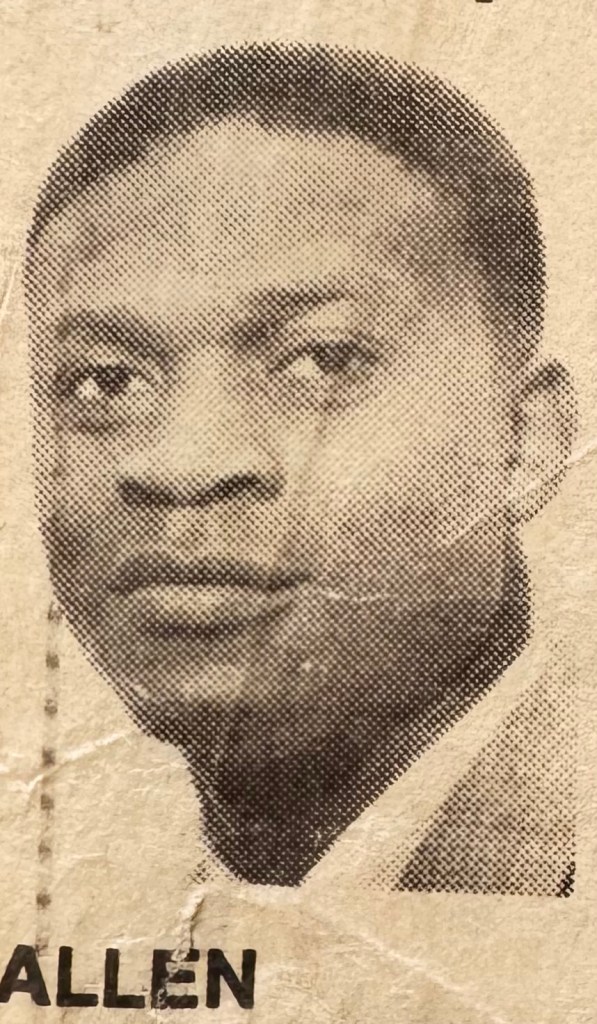
Reginald Allen, a 36-year-old campus security guard from Hackensack, was cut on a leg with glass but refused medical treatment.
Three hours after the shooting, police confiscated a revolver from the car of Anthony Christopher Brown, an 18-year-old FDU student from Huntington Station, N.Y. No charges were filed Friday against Brown.
Caption: PHOTO – ED HILL / THE RECORD – Alexander McLucas Jr. of Newark was injured in the FDU brawl.
By Michael O. Allen, Record Staff Writer | Friday, September 14, 1990
The Record (New Jersey) | Four Star | NEWS | Page B03
Two motorists were hospitalized and a section of Route 208 in Franklin Lakes was closed for more than four hours Thursday morning after a rush-hour accident.
Police said a rear-end collision between two cars in a northbound lane sent one of the cars careening into two vehicles in the southbound lanes.
Franklin Lakes traffic officer William Colligan said the accident occurred at about 7:15 a.m. He described the scene as a “mess.”
“Route 208 is a major highway and it occurred at rush hour, so you can imagine how backed up traffic was,” Colligan said. “But we had sufficient police to divert the traffic to county roads” and get motorists “to where they wanted to go.”
Three of the four drivers were injured, and two were hospitalized.
Carl Bayer, 47, of Ringwood suffered multiple fractures and was in stable condition at The Valley Hospital in Ridgewood, and Frank Miller, 22, of Dumont was in good condition at Hackensack Medical Center with minor injuries.
A 26-year-old woman police did not identify was treated at The Valley Hospital and released. The fourth motorist, George Frey, 34, of Hewitt, was not hurt.
Authorities said the woman was driving a Chevette that struck Miller’s Lincoln Continental as it was traveling north near Ewing Avenue.
The Lincoln went across the grassy median, struck Bayer’s Ford Thunderbird, spun around, and was struck by Frey’s Chevrolet Blazer.
Colligan said Route 208 around the Ewing Avenue exit was closed to traffic until 11:30 a.m. so investigators could gather evidence.
Two police officers from Oakland, three from Wyckoff, and members of the Bergen County Police Department helped divert traffic.
The Bergen County Prosecutor’s Office, the county police, and the Franklin Lakes detective bureau are investigating.
Colligan said that although investigations were still at a preliminary stage, he did not expect criminal charges or summonses to be issued.
Caption: PHOTO – PETER MONSEES / THE RECORD – Wreckage blocking the southbound lanes of Route 208 in Franklin Lakes on Thursday. Three of the four drivers involved were injured.
By Michael O. Allen, Record Staff Writer | Thursday, September 13, 1990
The Record (New Jersey) | Two Star | NEWS | Page A01
A cabby who witnessed a hit-and-run accident that injured an elderly pedestrian Wednesday pursued the fleeing driver and repeatedly tried to talk him into returning to the scene.
But Peter Byrne of Ridgefield Park, who works for Mr. Taxi Yellow Cab Co. of Hackensack, said the youth kept pulling away, so he continued to follow him.
Finally, at Harvey Avenue in Rochelle Park, he bumped the youth into a corner driveway and blocked him off as a state police cruiser that also was involved in the chase pulled up. A 17-year-old Hackensack youth, whom authorities declined to identify because of his age, was arrested.
Byrne said he had just dropped off passengers at about 1:40 p.m. when he saw the youth’s car strike Arthur Dehardt Jr. as he crossed West Passaic Street in Rochelle Park. The Bergen County Prosecutor’s Office said the youth ran a red light at the intersection.
Dehardt, 77, of Rochelle Park, was taken to Hackensack Medical Center with head and rib injuries and was in stable condition Wednesday, authorities said.
“The driver pulled up on the sidewalk, looked at him, and then took off,” Byrne said. “I thought he was going to stop. Then when he pulled away I pulled up next to him and said, `Hey, where you going? You just hit the man. But he just took off. So I made a U-turn and just went after him. “
Byrne, 46, who started working for Mr. Taxi 11 months ago after 25 years as an offset printer, said he kept after the youth, trying unsuccessfully to get him to go back.
After chasing him for about a mile, and jumping out at red lights to urge him to return to the scene, Byrne said he bumped the rear of the youth’s station wagon and forced him into the driveway.
The youth was charged with driving without a license, leaving the scene of an accident, reckless driving, and disregarding a traffic signal. He was driving his mother’s car, authorities said.
Rochelle Park Police Chief William Betten called Byrne a hero.
“We are extremely pleased with the efforts and cooperation [of Byrne] because it was his effort that resulted in the arrest of this hit-and-run driver,” Betten said. “He deserves all the credit he can get. “
Byrne said he did not consider himself a hero.
“I feel like I’ve just done something that anybody would do,” said the cabby.
The Record (New Jersey) | Four Star B | NEWS | Page A01
Two homeless men were charged with three city burglaries after police caught one of them after he emerged from a second-floor window with stolen money, police said.
Pedro Cordeiro, 20, and Frank Hidalgo, 22, were to be sent to the Bergen County Jail on Thursday on $2,500 bail.
Cordeiro was caught stepping onto a ladder after emerging from the window of a Hudson Street home. He was found with $154.90 allegedly stolen from the residence. Officers Richard Melber and Vincent Pedone had come to the home after receiving a call about a suspicious person about 9:30 p.m. Wednesday.
Cordeiro’s alleged accomplice, Hidalgo, fled when he saw the officers. They captured him about 1:30 a.m. Thursday.
The men admitted stealing a 21-inch color television from a Lodi Street home last week and $50 and an unknown quantity of cigarettes from a Hudson Street store two weeks ago, said Capt. Emil Canestrino.
By Michael Allen, Free Press Staff Writer | Friday, June 23, 1989
Joe Martin and Shirley Boucher were not the only people who befriended Dennis Racine.
The street also brought Racine the friendship of “Action” Jackie Marselli, 41, a former welterweight boxer – now a transient – who wants to fight again some day. He recently suffered a cut under the left eye and deep wounds on his knuckles.
“Won’t be long before Johnny Scully is middleweight champ of the world,” Marselli said. “He’s with Moochiein Hartford.”
Racine also came to know Ed Ritchie, a 42-year-old street person who said he has had three attacks.
Racine’s best friend, Martin, often totters on spindly 1egs. A mop of unkempt brown hair covers his head and face and a pair of blue jeans hang at his waist.
“I’ll take me a bath next year,” Martin joked. “I’ve got a lung problem. I’m dying. I have lung cancer, right. So, I don’t cut any corners. I do what I want to do.”
Bill Provost said he sometimes fears he is going to end up like Racine. Provost, 32, said he has lived on and off – mostly on – the street for much of his life. He said his chances of making it off the street were set back last year by a drunken-driving conviction that cost him his driver’s license and earned him 120 days in the Chittenden Community Correctional Center.
On the evening of the vigilfor the transients who died, Provost was standing on North Street, leaning against the same brick wall Racine leaned on when he was alive. Albert Ploof, 72, who lives next door, was standing next to Boucher.
Boucher asked Provost: “Why are you on the street? Why do you live the way you do? Are you doing this because you are out of choices, or is this the way you want to live?”
“It’s kind of a messed up situation really,” Provost replied. “I come down here because these are my friends.”
“Do you have a home?” Boucher persisted.
“Yeah.”
“Why do you choose not to go to it?”
“It’s hard to say,” Provost replied in exasperation.
“Do you ever think of the good Lord and ask him to help you?” interrupted Ploof, who said he’s a recovered alcoholic. “I did.”
By Michael Allen, Free Press Staff Writer | Friday, June 23, 1989
Framed by giant ash and poplar trees, the hobo encampment along the banks of the Winooski River was a special place for Dennis Racine.
In 1983 he and Joe Martin had built the encampment, a sheltered area filled with armchairs, mattresses, cupboards, bookcases, a clothesline, a toilet, a file cabinet and a plastic drum – things the men dragged there over the years.
Racine died three weeks ago in a favored armchair in the encampment, and Martin mourned his loss at the camp as the sky grew dark, the mosquitoes grew fiercer and a tree limb burned in a fire nearby.
“I’ll tell you how Dennis lived. Dennis was my best buddy – my partner for 30 years,” said Joe Martin, who first met Racine when the two were teenagers in Burlington. “We drank together.”
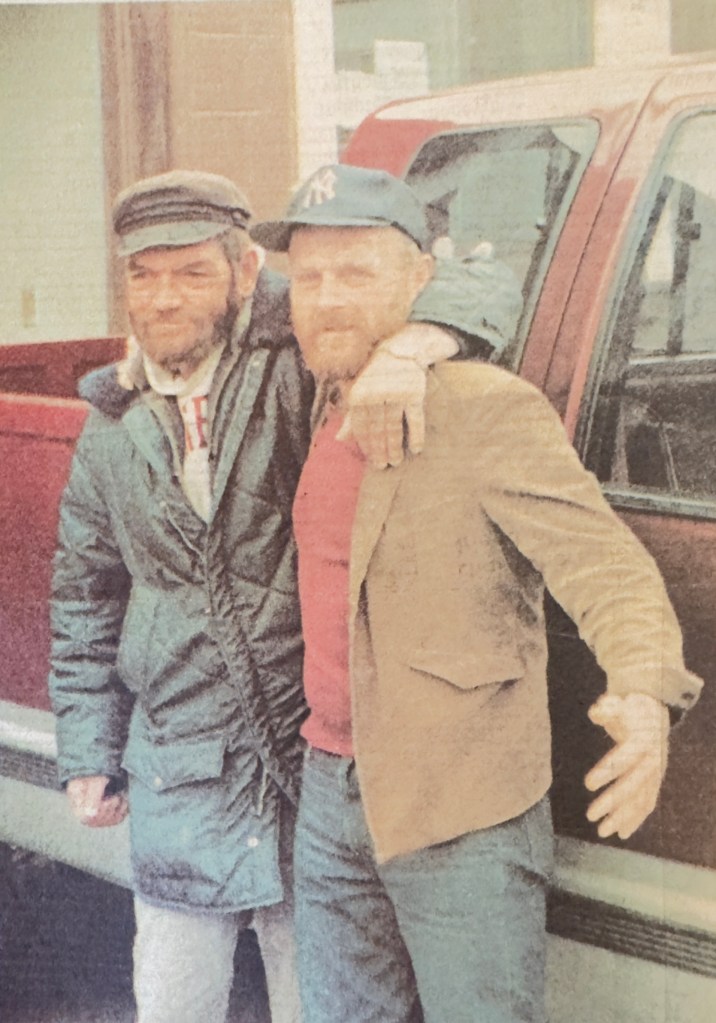
Dennis Racine, above left, and his friend ‘Action’ Jack Marselli, above right, stand in front of the Emergency food Shelf in Burlington on May 9, less than a month before Racine died. Credit: JYM WILSON, Free Press
“I never thought in my born days that Dennis will die in a chair without me. I’m the one with the bad lungs,” Martin said, pointing to an armchair covered with a sheet.
“What they said was, he curled up and died of his own phlegm. I expect that to happen to me because I’m a cougher and a hacker. But, Denny …” He shook his head in disbelief.
Racine spent 25 years as a street person – becoming a fixture on North Street in Burlington’s Old North End. His friends said he went to the street to die.
“When I die, I want to die alone; by the river,” his friends recalled him telling them time and again. “I don’t want no tears; I don’t want no flowers.”
When his final hour came the evening of June 1, Racine, 29 days short of his 44th birthday, went to the encampment by the river, got into his favored armchair and died.
He was the best known of the three transients who died between May 30 and June 1, officials said. Police have ruled the deaths of Oinus Jones and Keith Destrom, who died that same week, were homicides.
But Racine died of natural causes, a victim, perhaps, of years of heavy drinking and living on the streets. Dr. Eleanor McQuillen, chief state medical examiner, said he was in a position in the chair that pressured his chest cavity, stopping his breathing. Blood tests to see if alcohol contributed to his death are pending.
The street people who were Racine’s closest friends were not allowed to view his body before it was cremated. They were not allowed to pay their respects.
Michael Allen, 26, has joined the Free Press as a reporter. Allen holds a bachelor’s degree in mass communication and journalism from Southern IllinoisUniversity at Edwardsville. He has been a news researcher, reporter and editor for the Associated Press in New York City and has reported for a variety of Midwest papers.
Story by Paige St. John, The J-student | February 1, 1984
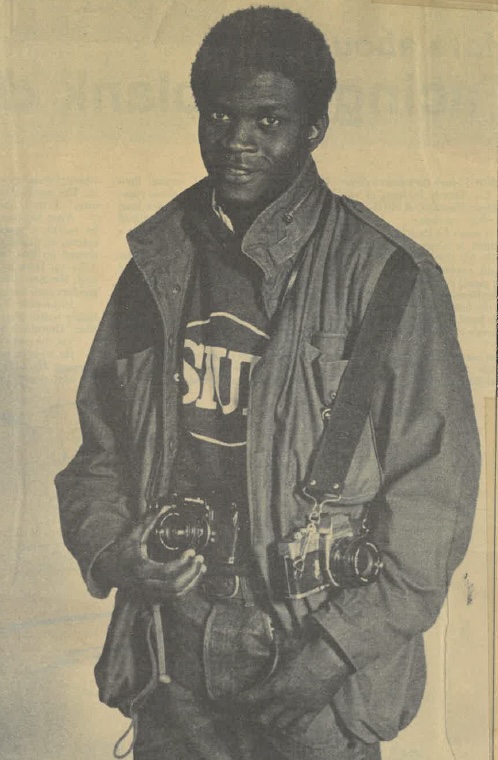
SIUE Mass Communications major Michael Allen went underground on campus. Photograph by Scott Cousins
For a week, Michael Allen, a senior at SIUE, had been sleeping on a picnic table at the Tower Lake Recreation Area on campus.
Each evening in the summer dusk he jumped over the locked gate to the recreation area, and found his spot under a pavilion by the lake. He pulled off his clothes—a T-shirt and a pair of shorts—and rolled them into a bundle to pillow his head.
There he slept.
Before the sun came up he would be dressed again and gone … on the move, no place to live, dispossessed from the Tower Lake Apartments, living underground at the university.
“One night. I was asleep when I felt a light on me. I actually felt it. I got up and I didn’t have any clothes on and this light was on me,” Michael recalls. “I couldn’t believe that the policeman couldn’t see me.”
A campus patrol car was making a routine check of the recreation area with its car search light. Michael jumped up and ran behind one of the pavilion post, to avoid being seen.
The patrol car moved on.
“I couldn’t sleep that night,” Michael says. “In the morning, l got dressed and started to leave, but that police car was still parked there right at the gate. I had a very big problem at that point. I didn’t know how to swim so I couldn’t get across the lake that way. I had to walk around the edge of the lake (to the other side of the peninsula the recreation area sits on). I had to climb over the fence on that side.”
Then began his typical college day, scavenging for the necessities of life. In the mornings, he had no idea where he would eat, where he would sleep, whether he would be able to hang on at SIUE.
“That was quite exciting, doing that,” Allen now says. “Those were very big times. I enjoyed sleeping out there at night because it felt like the whole place, the whole world, was mine. The stars were beautiful. The one big disadvantage was the mosquitoes and the bugs. But the police scared me so much, after that night, I never went back to the Tower Lake rec area.
Michael Allen had to go underground because he had been evicted from his only place to stay. The problem started last June when he left the university’s Tower Lake Apartments with about $500 in back rent due. With a debt like that, he could not get a housing contract for the summer term at SIUE. He didn’t want to drop out of college, he had barely a term or two left before graduation.
“I just packed my stuff and look it over to Steve’s,” Allen says. Steve. a friend of his, rents a house. Michael’s belongings—everything but a pair of shorts and a T-shirt—were stored in the basement of the house.
For three months afterward, Allen had no place to live, no job, no money. He slept on campus, mostly in empty tract houses. He slept in the shed where athletic equipment is stored, using a high jump mat as a mattress. He slept on picnic tables. He slept occasionally on friends’ couches. In a few cases, on their doorsteps.
He borrowed money, he borrowed food, and a few times he borrowed clothes.
All of the time he stayed on campus, hoping things would get better.
Eventually, they did. By the end of the summer he found a job in St. Louis, qualified for student financial aid, paid off the debt to Tower Lake Housing, and was allowed back in.
Now he is found in his Tower Lake apartment, warm and clean and fed, making plans for graduation.
Michael Allen, who was born and raised in Nigeria, is among a small number of students hit hardest by hard times who somehow manage to stay in school and get their degrees.
Allen traces his troubles back to 1979 when he first enrolled at SIUE. He said he wanted to be a soccer player, but he never made the team. He thinks it is partly because he is a Nigerian, and the SIUE team prides itself on American boys.
An introverted person, he did not make many friends. “If I had had those friends, I would have had more people to go to for help when I needed it,” he says.
Allen was not as lucky. His best friend was a resident manager at Tower Lake, whose responsibility, unfortunately, is to see that only paying customers stay in the apartments.
Michael went to other acquaintances. After awhile, they began to disappear.
“Along the way, as time passed, those people got fewer and farther in between. I couldn’t blame them. I wouldn’t want someone who is depressed hanging around me all of the time.”
For three years at SIUE, Michael Allen was a successful student with above-average grades. He had an occasional withdrawal from class or low grade, but the A’s and B’s on his academic transcript show he was doing well.
In the fall of l982 he found a job at the Kroger store in Edwardsville, working the night shift as a janitor. Just one month later, he was offered a part-time job at the Belleville News Democrat. As a a journalism student, he jumped at the chance to be a reporter. He quit his janitorial job.
Four months later, he says, he found himself in the editor’s office, being told someone else was being hired to replace him at the newspaper.
He was being fired.
“My whole world just fell right at my feet,” Michael says. “That was one big disappointment then. But, it was only a setback. I had saved some money. I figured, hey, I would go for the Capital Cities (newspaper) internship program.”
In March Michael Allen was turned down for the paying internship program. He had seemed a likely candidate for the job until the typing test. Michael could not type.
He sleeps in tract houses and empty sheds
“It floored me. I think I even started missing classes then, and I don’t miss classes at all,” he said.
Winter quarter was hard on Michael. “I let everything slip by. I couldn’t pay my fees and I couldn’t pay my rent. I started doing things to get by. I would borrow $5 here and there from friends. Soon, those things began to pile up on me.”
He was, all the time, trying to find another job.
“I tried everything. I started applying for a janitorial job. l think things were quite rough for everyone that point, because there were no jobs at all. I kept thinking it was something else. It is very hard to say to yourself it’s got to be me.”
Depressed, he stopped going to classes. “Things were pretty bad but I should have been able to do something. But for some reason, I couldn’t do anything … ! don’t know if I can use the words ‘couldn’t do anything.’ I DIDN’T do anything.”
Psychologically, he was paralyzed.
The end of spring quarter came and he had to give up his Tower Lake home.
One of the people Michael eventually went to for help—after living for several weeks hand to mouth—was then-Dean of Students Dan Doelger. It was Doelger’s job to take care of problem student cases. Doelger could not provide students with instant housing or instant money or instant campus jobs. He could, however, pull a few strings to speed up the promise of help.
The university does make emergency short-term loans to students, but only if they do not owe money to the school. Michael Allen owed money.
Michael Allen applied for a state educational grant soon after he lost his Tower Lake apartment. He would not get the money, if he qualified, for several months. It was up to him to find a way to live until then.
He stayed and became a bag man.
“I had a bag—a shopping bag—and in it was a towel, a toothbrush and a tube of toothpaste and a blanket. I kept it in my car, which was parked by Tower Lake. It had no gas in it and I couldn’t move it anyhow. The window broke and when it rained my stuff got wet.”
After a week of sleeping at the lake, he had his escapade with the patrol car. He had to find someplace else to stay.
“I borrowed $20 from Joe, a friend, and put some gas in my car. I drove it to the soccer field parking lot and I was going to sleep in it there. Before I know it, there was a police car. He told me I couldn’t sleep there.”
Allen drove the car back to Tower Lake, parked it and then walked back to the soccer field. There are two sheds on one side of the track field behind the soccer field. One of them had a high jump mat inside it. That became home for the nights.
“I’d take a semi-shower at the water fountain in the morning,” he said. “During the day I went to places to try to find a job. Granite City, the Ramada Inn . . . all the time I was starving. I know starving, there was never a time in my life when I didn’t starve, so it wasn’t so bad.”
Michael Allen was raised in Nigeria. Hunger is familiar to him, he says. “I thought coming to the United States was going to be paradise. People do not starve in the United States.”
He laughs at his naivete.
Occasionally it was too cool to sleep on the high jump mat. Sometimes, too, the mosquitoes were too fierce. Then, Michael would cross the street to an empty tract house where the Human Services Department once was located.
“For a long time, most of the summer, I slept at the tract house or the shed.”
His one pair of short became permanently dirty. He had to throw the T-shirt away.
Food became an obsession.
“I would visit people and stay until they ate. They would almost have to give me something. Sometimes I would fall asleep on the couch deliberately, so I could stay. I was degrading myself. I know it. I always felt highly about myself but that started to change. They would say, ‘Wake up, Michael, we’re going to bed now and you can’t stay.’ Well, I had to get up, but sometimes I would sleep at their doorstep. I had nowhere lese to go.”
Michael Allen called Tower Lake Housing and asked if he coud stay in one of the empty apartments until the end of summer. He was told “no.” He does not understand, even now, why.
“There are a lot of vacant apartments here over the summer. Why couldn’t I stay there?”
Tower Lake Housing resident life coordinator, Joe Horvath knows quite well why he can’t let someone stay free in vacant apartments. “Tm also incurring an expense for him to sit in there—just the utilities alone can be quite expensive,” according to Horvath.
The resident life officers often work out ways for students to stay at Tower Lake while they pay past due rent. Horvath will not, however, let a student stay for free. “We don’t allow that any place. We’re not here to subsidize students. We’re here to help them get through school.”
Most of Horvath’s work is spent trying to prevent students from getting into debt as far as Michael Allen did. When a student is one or two months behind in rent, the problem is a lot more solvable. “We sit down with them or a resident manager sits down with them and we say, ‘Let’s work down all your belly needs, your expenses, and let’s work down all vour income for the year.’ We want to know if this is a long term problem or a short term problem. Most of the time it is short term, like they are waiting for their Pell Grant Lo come through.”
If a student cannot pay rent because he has not received grant money, the resident life office will let the student stay until the grant arrives.
The resident life officers will help the Tower Lake student make out a budget. Often this financial counseling is enough to get the student back on his feet, out of arrears with SIUE. “A lot of them are freshmen and sophomore and hadn’t had to work out a budget before in their lives. Now school for a year here will cost about $3,500, tuition and room and board. When you tell a student that ‘you’re going to have to get $3,500 this year,’ that’s a lot of bucks. They never thought of it that way,” Horvath says.
“I’ve been here since 1979 and in that time, of all the students who have come to me for help, not the ones who owe and then just walk out, I’ve had only one student that did not pay.”
The students he has problems with are the ones he never talks to. Like Michael Allen. “We have some that for some reason just get p and walk out.”
Sometimes, the walkouts do come back and make good their housing debts—as Michael Allen did.
“The exceptional situation develops sometimes,” Horvath says. “There are two students, let’s say they were athletes, and the two of them incurred $200, $300 on their (checkout) ticket for damage to the apartment. After about two years, one of them wanted to come ack to school. I said OK, we’ll work this payment out over a period of time, but anytime you become delinquent, you will be cut off from registration. I think he’s still here. He would be a junior now.
I know the saying’s trite, but it’s true. We spend 95 percent of our time with 5 percent of the people. Of that, a lot of them are delinquent for one month only. Just a very few of them get in really bad shape.”
For a long time, a Tower Lake policy requiring students to pay 20 to 30 percent of their quarter’s rent ahead of time, plus the $500 Michael Allen owed in back rent, prevented him from getting a housing contract. “It was close to $1,000 I’d have to pay right away,” Allen says.
He managed to get into housing later, when he had applied for and been granted a student loan. The money barely paid off what he owed in back rent. He was given a housing contract at the end of August but he would have to wait until Sept. 17, the official moving-in date, before he could occupy an apartment.
At about the same time, toward the end of summer, Michael Allen finally found a job. He replied to a classified ad from an employment agency. The agency found him a job as a prep cook in a St. Louis restaurant. To get the job, Michael said he had experience as a cook. He figured he would just learn quickly on the job.
For the vital job interview, Allen went to his friend who was keeping his things for him and got a pair of pants. He borrowed a shirt from another friend and a jacket from still someone else. He got the job at minimum wage and “all of a sudden my problems were not so great.”
Then his car died.
Problems were building again. That was when a policeman caught him sleeping in the empty tract house on campus.
“The police picked me up. They figured since I am a foreign student to call the foreign student advisor, Katherine Kumler. She let me sleep at her house for two days.
“I just didn’t feel right there, though, and when they left on vacation, I left. too.”
Then on Sept. 17, Michael Allen moved into Tower Lake. On Nov. 21, he received money from a federal grant and a student loan. He spent almost all the money immediately. paying what he owed in rent and tuition. He also sold his car scrap metal, $350 from a junk dealer.
In the apartment now, with his belongings once again under the same roof, t is hard or Michael to relive summer underground.
“Things have gotten so comfortable in an apartment, in a bed, I can’t imagine doing what I did then. Now, sitting here, I can’t imagine that I could do the same thing over again.”
Michael Allen does not look different. He lost some weight but he’s gaining it back.
Inside, there’s a difference, however.
“I was downgraded,” he says. “A lot of those things did so much to me personally. It has really affected my self image, my self respect.”
Allen’s case is infrequent at SIUE.
It is remarkable, however, for a student to hang on with so much determination.
“I had to stay here because of my education,” Allen says. “If I went to Chicago (his hometown), I could find a job, sure, but the kind of job that I will end up making some girl pregnant and having to get married and not making enough money and working everyday for nothing.
“I won’t be able to get a good job without an education. The degree, that is absolutely essential.”
It’s hard (and strange) to continue quibbling about a story that was published 42 years ago (I am writing this in 2026) in a student publication.
Paige St. John was a friend and we were in the same journalism program. She was someone that I admired. I confided a lot of the details in this story to her and some friends in our journalism program. She may have asked me if she could write a story about my experiences. I am sure I did not give consent. Hence, there were a few errors in the story.
For instance, I was born in Ghana, not in Nigeria, as the story states. I was raised in Nigeria.
Also, as it turned out, I did not graduate in 1984, as the story stated. I did drop out of school and went back to Chicago for a spell to earn the money to finish my degree in 1987.
I felt betrayed and I was angry with Paige and I never spoke to her after the story ran. I was, nevertheless, proud of her when she was awarded the 2011 Pulitzer Prize for investigative reporting for the Sarasota Herald-Tribune.
Lorem ipsum dolor sit amet, consectetur adipiscing elit, sed do eiusmod tempor incididunt ut labore et dolore magna aliqua. Quam pellentesque nec nam aliquam sem et tortor consequat. Iaculis at erat pellentesque adipiscing commodo elit at imperdiet dui. Sapien eget mi proin sed libero enim sed. In egestas erat imperdiet sed. Faucibus pulvinar elementum integer enim neque volutpat ac tincidunt. Suspendisse interdum consectetur libero id faucibus. Turpis tincidunt id aliquet risus feugiat. Purus gravida quis blandit turpis cursus in hac habitasse. Mattis enim ut tellus elementum sagittis vitae. Integer quis auctor elit sed vulputate mi. Malesuada fames ac turpis egestas sed tempus urna et. Eu ultrices vitae auctor eu augue. Faucibus ornare suspendisse sed nisi. At risus viverra adipiscing at. Ipsum dolor sit amet consectetur adipiscing. Iaculis eu non diam phasellus. Gravida quis blandit turpis cursus in hac habitasse platea dictumst. Fames ac turpis egestas integer eget. Nam aliquam sem et tortor consequat id.
Lorem ipsum dolor sit amet, consectetur adipiscing elit, sed do eiusmod tempor incididunt ut labore et dolore magna aliqua. Quam pellentesque nec nam aliquam sem et tortor consequat. Iaculis at erat pellentesque adipiscing commodo elit at imperdiet dui. Sapien eget mi proin sed libero enim sed. In egestas erat imperdiet sed. Faucibus pulvinar elementum integer enim neque volutpat ac tincidunt. Suspendisse interdum consectetur libero id faucibus. Turpis tincidunt id aliquet risus feugiat. Purus gravida quis blandit turpis cursus in hac habitasse. Mattis enim ut tellus elementum sagittis vitae. Integer quis auctor elit sed vulputate mi. Malesuada fames ac turpis egestas sed tempus urna et. Eu ultrices vitae auctor eu augue. Faucibus ornare suspendisse sed nisi. At risus viverra adipiscing at. Ipsum dolor sit amet consectetur adipiscing. Iaculis eu non diam phasellus. Gravida quis blandit turpis cursus in hac habitasse platea dictumst. Fames ac turpis egestas integer eget. Nam aliquam sem et tortor consequat id.


 https://michaeloallen.com/