Not getting the Times

Yesterday, the leading Democratic candidate for President, Sen. Barack Obama of Illinois, came to New York City to deliver a major speech on the economy right at the time when the economy appears to be teetering on the edge of a deep recession.

He was introduced by Mayor Michael Bloomberg who himself had flirted with making his own presidential bid as an independent. The two had breakfast. Then the Bloomberg gave Obama a rather warm introduction before his speech at Cooper Union. Obama came to the podium and said, essentially, luv you back, Mr. Mayor.

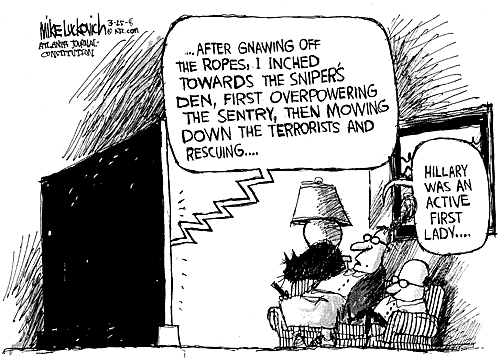
So, what did The New York Times put on its front page?

You guessed it, its own story on an interview it had with Sen. Hillary Clinton, (D-NY), about her healthcare plan.

Hello? Earth to The New York Times!

'You Who . . .'

1. ‘Voi ch’ascoltate in rime sparse il suono’

You who hear the sound, in scattered rhymes,
of those sighs on which I fed my heart,
in my first vagrant youthfulness,
when I was partly other than I am,

I hope to find pity, and forgiveness,
for all the modes in which I talk and weep,
between vain hope and vain sadness,
in those who understand love through its trials.

Yet I see clearly now I have become
an old tale amongst all these people, so that
it often makes me ashamed of myself;

and shame is the fruit of my vanities,
and remorse, and the clearest knowledge
of how the world’s delight is a brief dream.

–Petrarch, 1342

Fagles, R.I.P.

I remember carrying around Robert Fagles translation of Homer, dipping in occasionally.

Years later, I became enthralled when I came across a rare copy of Alexander Pope’s 1802 translation of “The Odyssey.” I paid too much money for it and spent seven times what I paid for it restoring the book. The two volumes sits on a shelf in my house now. I don’t dare open them, for fear of damaging them. I bought paperback copies of them and I read those.

Fagles, who managed somehow to make the classics readable, died this past week.

March 29, 2008
SIDEBAR
Translating Homer: To Each His Own Muse

Robert Fagles’s translations departed markedly from those of his predecessors, as shown below in the opening lines of “The Odyssey.”

Robert Fagles (1996)

Sing to me of the man, Muse, the man of twists and turns
driven time and again off course, once he had plundered
the hallowed heights of Troy.

Robert Fitzgerald (1961)

Sing in me, Muse, and through me tell the story
of that man skilled in all ways of contending,
the wanderer, harried for years on end,
after he plundered the stronghold
on the proud height of Troy.

Alexander Pope (1726)

The Man, for wisdom’s various arts renown’d,
Long exercis’d in woes, O Muse! resound.
Who, when his arms had wrought the destin’d fall
Of sacred Troy, and raz’d her heav’n-built wall. . . .

George Chapman (1616)

The man, O Muse, informe, that many a way
Wound with his wisedome to his wished stay;
That wanderd wondrous farre when He the towne
Of sacred Troy had sackt and shiverd downe.

A misnomer

I can’t say that I’ve ever spent much time pondering why they call this class of computer electronics ‘smart phone,’ but now that John Lancaster mentions it . . .

Here’s Mr. Lancaster:

There is no getting around the fact that the things sound demoralisingly nerdy. To the lay consumer, what “smart” means is “horribly complicated, unnecessarily over-specified, dominated by features no sane person will ever use, liable to do ruinously expensive things to your data tariff without your realising until too late, and weirdly bad at everyday stuff like, you know, making phone calls”.

I want an i Phone, of course, but not at the going rate. The writer had one and marvels at what’s coming down the pike:

So the task for the manufacturers is to make smartphones as simple-seeming and easy as possible, and let the features sort of sneak up on the user – and one way round this is to make the interface as intuitive as possible, so the underlying complexity is hidden. That way, non-nerds will buy them. Engineers need careful handling if they’re to do this right: consider the VCR, for instance, which over time got more rather than less complicated, so that nobody over the age of about 30 could make one work.

LG has had a good go at this and the KF600 menu structure is about as clear and helpful as anything apart from Apple’s iPhone. It uses two screens, the lower one a sliding touch screen with four-way arrows, and the menus are context-sensitive and interactive in a helpful way: so when you’re playing music, they’re play and pause controls; when you’re scrolling through contacts, they’re to do with ways of contacting people, and so on. The phone puts few obstacles in the way of actually being used. I had to RTFM a couple of times, but nothing untoward. And call quality is OK – not fabulous, but OK.

As to whether the phone will win converts, I’m not so sure. My first ever smartphone was an iPhone, and it’s a marvel of usability – but it also makes me keenly aware of just how miraculous these phones are about to be, a year or two down the line, when they have 3G and GPS that really, truly works. That, for the lay user, will mean broadband everywhere, all the time, and that your phone knows exactly where you are. That will seriously rock.

Not so midas

If you’re Apple, I would have to think this is probably not a problem you want to be having.

I want my own macbook pro oh so bad. But, is this a problem I should be taking into consideration? My personal experience with Apple is that the products are very good quality and that they’ve taken care of any problem that I’ve had with products promptly. But I’d rather not have the problem in the first place.

As this Guardian article notes, it’s a long-standing problem and caused the demise of one cool apple product, the cube computer.

‘Renewing the American Economy’

Text of Sen. Barack Obama’s speech at Cooper Union in New York on Friday, March 27, 2008, as prepared for delivery and provided to The New York Times by his campaign.

I want to thank Mayor Bloomberg for his extraordinary leadership. At a time when Washington is divided in old ideological battles, he shows us what can be achieved when we bring people together to seek pragmatic solutions. Not only has he been a remarkable leader for New York –he has established himself as a major voice in our national debate on issues like renewing our economy, educating our children, and seeking energy independence. Mr. Mayor, I share your determination to bring this country together to finally make progress for the American people.

In a city of landmarks, we meet at Cooper Union, just uptown from Federal Hall, where George Washington took the oath of office as the first President of the United States. With all the history that has passed through the narrow canyons of lower Manhattan, it is worth taking a moment to reflect on the role that the market has played in the development of the American story.

The great task before our Founders that day was putting into practice the ideal that government could simultaneously serve liberty and advance the common good. For Alexander Hamilton, the young Secretary of the Treasury, that task was bound to the vigor of the American economy.
Continue reading “‘Renewing the American Economy’”

McCain-iacs

I have been saying all along that media types are suckers for Sen. John McCain, (R-AZ), especially over at Newsweek. I don’t know why he wastes money having a media relations staff when most people in the industry are more than happy to be his toady.

Now, Neal Gabler explores the issue on the op-ed page of the Times.

The Audacity to Hope

‘Audacity to Hope,’ pt. 1

The full text of Jeremiah Wright’s “Audacity To Hope” sermon in 1990:
Several years ago while I was in Richmond, the Lord allowed me to be in that city during the week of the annual convocation at Virginia Union University School of Theology. There I heard the preaching and teaching of Reverend Frederick G. Sampson of Detroit, Michigan. In one of his lectures, Dr. Sampson spoke of a painting I remembered studying in humanities courses back in the late ’50s. In Dr. Sampson’s powerful description of the picture, he spoke of it being a study in contradictions, because the title and the details on the canvas seem to be in direct opposition.
The painting’s title is “Hope.” It shows a woman sitting on top of the world, playing a harp. What more enviable position could one ever hope to achieve than being on top of the world with everyone dancing to your music?
As you look closer, the illusion of power gives way to the reality of pain. The world on which this woman sits, our world, is torn by war, destroyed by hate, decimated by despair, and devastated by distrust. The world on which she sits seems on the brink of destruction. Famine ravages millions of inhabitants in one hemisphere, while feasting and gluttony are enjoyed by inhabitants of another hemisphere. This world is a ticking time bomb, with apartheid in one hemisphere and apathy in the other. Scientists tell us there are enough nuclear warheads to wipe out all forms of life except cockroaches. That is the world on which the woman sits in Watt’s painting. Continue reading “The Audacity to Hope”